

















 Follow Us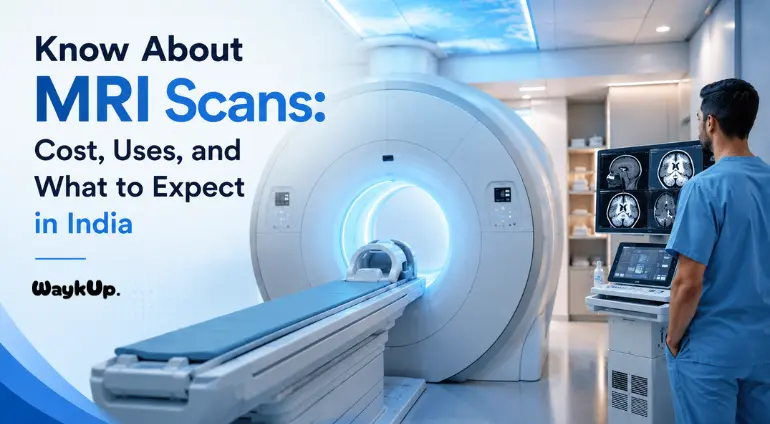
Getting told you need an MRI scan can feel a little intimidating – especially if it is your first time. The machine looks like something out of a science fiction film, the sounds it makes are genuinely strange, and if you have been searching online, you have probably found wildly different numbers when it comes to MRI scan cost. It is confusing, and that confusion is completely understandable.
This guide is here to cut through the noise. Whether you are asking what is an MRI scan, wondering about MRI scan cost in India, trying to understand the difference between a CT scan vs MRI, or looking for an MRI scan near me – you will find clear, honest answers here. Written with real patients in mind, and backed by medical understanding, this is the guide you wish you had found first.
What is an MRI Scan? Understanding the MRI Scan Full Form
Let us start at the beginning. The MRI scan full form is Magnetic Resonance Imaging. The name tells you exactly how it works: the machine uses powerful magnetic fields combined with radio waves to create detailed images of what is happening inside your body.
Here is a simple way to understand it. Your body is made up mostly of water, and water contains hydrogen atoms. When you lie inside an MRI machine, the strong magnetic field causes these hydrogen atoms to line up in a particular direction. The machine then sends out radio waves that briefly knock them out of alignment. As they snap back into place, they release tiny signals. A computer picks up those signals and converts them into highly detailed, cross-sectional images of your organs, tissues, muscles, and bones.
What makes an MRI scan genuinely remarkable is that it does all of this without using any radiation. Unlike X-rays or CT scans, there is no ionising radiation involved, which makes it one of the safest imaging methods available – especially for people who need repeated scans over time.
Doctors use MRI scans to examine and diagnose a wide range of conditions including brain tumors, spinal cord injuries, torn ligaments, joint damage, soft tissue masses, multiple sclerosis, stroke, heart conditions, and reproductive organ issues. It is particularly powerful for imaging soft tissues – the brain, spinal cord, nerves, and muscles show up with exceptional clarity on an MRI.
Read Also – Yoga: Methods, Types, Philosophy, and Risks
CT Scan vs MRI: Which One Do You Actually Need?
One of the most common questions patients ask is: CT scan vs MRI – what is the difference, and which one should I be getting?
Both scans produce detailed internal images. Both require you to lie still on a table that moves through a circular scanner. But after that, they are quite different.
A CT scan (Computed Tomography) uses X-rays and computer technology to produce cross-sectional images of the body. It is fast – often done in as little as 5 to 10 minutes – which is why it is the preferred choice in emergencies and trauma situations. CT scans are excellent for visualising bones, detecting fractures, identifying internal bleeding quickly, and assessing lung conditions. They do, however, use ionising radiation.
An MRI scan, on the other hand, uses magnetic fields and radio waves with zero radiation. It takes longer – anywhere from 20 minutes to an hour – but produces far more detailed images of soft tissues. For brain conditions, spinal cord issues, neurological disorders, joint and ligament injuries, and reproductive organ assessment, MRI is almost always the superior choice.
Here is a quick breakdown:
- Choose CT scan when: speed matters (emergency diagnosis), imaging bones or fractures, assessing chest or abdominal organs quickly, or when the patient has metal implants that rule out MRI
- Choose MRI scan when: detailed brain or spinal imaging is needed, assessing soft tissue injuries or nerve conditions, evaluating tumors with greater precision, or when avoiding radiation is a priority
Cost-wise, CT scans are generally cheaper, typically ranging from Rs. 2,000 to Rs. 8,000 in India. MRI scans cost more due to the complexity of the equipment, generally ranging from Rs. 3,500 to Rs. 25,000 depending on the body part and type of scan.
When in doubt, always follow your doctor’s recommendation. They choose between these tools based on what they specifically need to see – and each tool has situations where it is genuinely the better option.
Read Also – Drumstick (Moringa): Benefits, Uses & Nutrition Guide
MRI Scan Cost in India: What You Will Actually Pay
This is where most people spend the longest time searching, and understandably so. MRI scan cost in India varies considerably depending on several factors: which part of the body is being scanned, the type of MRI machine being used, whether contrast dye is required, the city you are in, and whether it is a private hospital, a diagnostic chain, or a government facility.
Here is a realistic price guide for 2026:
Full Body MRI Scan Cost: Rs. 10,000 to Rs. 25,000. A full body MRI scan is typically used for comprehensive health checkups or cancer screening. It is the most time-intensive and comprehensive type.
MRI Brain Scan Cost: Rs. 3,500 to Rs. 8,000 for a standard brain MRI. For a contrast-enhanced brain MRI, the cost can rise to Rs. 8,000 to Rs. 12,000. In Delhi specifically, brain MRI typically costs between Rs. 5,000 and Rs. 15,000 depending on the centre.
Spine MRI: Rs. 6,000 to Rs. 18,000 depending on whether you need the cervical, thoracic, or lumbar region scanned.
Knee or Shoulder MRI: Rs. 4,000 to Rs. 10,000.
Factors that push costs higher include:
- Use of contrast dye (gadolinium injection), which adds Rs. 1,500 to Rs. 3,000 to the base price
- 3 Tesla machines, which offer sharper images than 1.5 Tesla machines but cost more
- Premium private hospitals in metro cities versus standalone diagnostic centres
- Expert radiologist consultation fees, which may or may not be bundled
Ways to reduce your MRI scan cost:
- Book through diagnostic aggregator platforms such as Practo, HOD, or Healthians, which often offer 30 to 60 percent discounts
- Check whether your health insurance covers MRI – most comprehensive plans do
- Government hospitals and CGHS empanelled centres charge significantly less
- Ask for a written referral from your doctor, which some centres require for insurance claims
Read Also – Detox Water: The Complete Guide to Health, Recipes & Usage
MRI Brain Scan Cost: A Closer Look
The MRI brain scan is one of the most frequently ordered MRI procedures in India. Doctors recommend it to investigate headaches that will not go away, memory loss, seizures, hearing or vision problems, stroke symptoms, suspected tumors, and neurological conditions like multiple sclerosis.
The MRI brain scan cost in India averages between Rs. 3,500 and Rs. 12,000 for a standard scan. Functional MRI (fMRI), which tracks brain activity in real time, is more specialised and more expensive. Contrast-enhanced MRI of the brain – where a dye is injected to highlight blood vessels or abnormal tissue more clearly – typically costs Rs. 7,000 to Rs. 14,000.
In cities like Delhi and Mumbai, HOD Care, Mahajan Imaging, and Aarthi Scans are among the well-known diagnostic centres that offer brain MRI services. Many also allow online booking with home sample collection preparation and digital report delivery.
Finding an MRI Scan Near Me: What to Look For
When you search for an MRI scan near me, you want more than just the closest result. Here is what actually matters:
Machine quality: A 1.5 Tesla machine is standard and adequate for most scans. A 3 Tesla machine offers higher resolution images, particularly useful for brain and joint imaging. Ask before you book.
Accreditation: Look for centres with NABH (National Accreditation Board for Hospitals) or NABL accreditation. This is a reliable marker of quality and safety standards.
Radiologist expertise: Your MRI report is only as good as the radiologist reading it. Reputed centres employ radiologists with subspecialty training.
Turnaround time: Some centres offer same-day digital reports. Others take 24 to 48 hours. If your case is urgent, ask upfront.
Open MRI availability: If you experience claustrophobia, ask specifically about open MRI machines, which are less enclosed. Most major cities in India now have at least a few centres offering this option.
What Happens During an MRI Scan: A Step-by-Step Guide
Many people feel anxious about MRI scans simply because they do not know what to expect. Here is exactly what happens:
You will be asked to change into a hospital gown and remove all metal objects – jewellery, hairpins, hearing aids, glasses. Metal interferes with the magnetic field, so this step is non-negotiable.
If your scan requires contrast dye, a nurse will insert a small intravenous line into your arm before the scan begins.
You will lie down on a padded table that slides into the MRI machine. The machine is a large, cylindrical tube. Staff will provide you with earplugs or headphones because the machine produces loud knocking and thumping sounds throughout the scan.
During the scan, you must remain as still as possible – movement can blur the images. The technician will monitor you from an adjoining room and can communicate with you through an intercom at all times. Most scans take between 20 and 60 minutes.
MRI scans are painless. The main discomfort, if any, comes from lying still for an extended period or from the enclosed space. If you have severe claustrophobia, speak to your doctor beforehand – mild sedation is an option.
Read Also – How to Reduce Belly Fat in 7 Days at Home?
Is an MRI Scan Safe? Understanding the Risks
For the vast majority of people, an MRI scan is completely safe. Because it uses no ionising radiation, it is considered one of the safest medical imaging procedures available.
There are a few situations that require extra attention:
Metal implants: Pacemakers, cochlear implants, certain surgical clips, and metal fragments in the body can be dangerous in an MRI machine due to the strong magnetic field. Always disclose any implants or metal in your body before the scan.
Contrast dye: Gadolinium-based contrast agents are generally safe but can cause reactions in people with severe kidney disease. Inform your doctor if you have kidney problems.
Pregnancy: MRI is generally considered safe during pregnancy when medically necessary, but contrast dye is typically avoided. Always inform the centre if you are or might be pregnant.
Claustrophobia: The enclosed space can be distressing. Speak to your doctor in advance if this is a concern.
Frequently Asked Questions (FAQs)
Q1: What is an MRI scan used for? An MRI scan is used to create detailed images of soft tissues, organs, the brain, spinal cord, joints, and blood vessels inside the body. Doctors use it to diagnose conditions such as brain tumors, stroke, multiple sclerosis, spinal cord injuries, torn ligaments, joint damage, and reproductive organ issues. Unlike X-rays, MRI is especially effective at visualising soft tissues that do not show up clearly on other imaging methods.
Q2: What does MRI scan full form mean? MRI stands for Magnetic Resonance Imaging. The name refers to the two technologies the machine uses – magnetic fields and radio waves – to generate detailed images of the inside of your body. It does not use X-rays or any form of radiation, which makes it one of the safest diagnostic imaging tools available.
Q3: How much does an MRI scan cost in India? MRI scan cost in India ranges from approximately Rs. 1,500 to Rs. 25,000 depending on the body part being scanned, the type of MRI machine, whether contrast dye is used, and the city and type of facility. A brain MRI typically costs Rs. 3,500 to Rs. 12,000, while a full body MRI scan cost in India ranges from Rs. 10,000 to Rs. 25,000. Booking through diagnostic aggregator platforms or at government empanelled centres can significantly reduce costs.
Q4: What is the difference between a CT scan and an MRI? A CT scan uses X-rays and is faster, making it better for emergencies, bone fractures, and quick internal assessments. An MRI uses magnetic fields and radio waves with no radiation, making it more detailed and better suited for brain imaging, soft tissue assessment, nerve conditions, and joint injuries. CT scans are generally cheaper and quicker; MRI scans take longer but provide superior detail for many conditions.
Q5: How much does a full body MRI scan cost in India? A full body MRI scan cost in India typically ranges from Rs. 10,000 to Rs. 25,000 depending on the facility, city, and whether contrast dye is used. It is the most comprehensive and time-intensive type of MRI and is often used for cancer screening or whole-body health checkups.
Q6: How do I find a reliable MRI scan centre near me? The best way to find a reliable MRI scan near you is to search on platforms such as Practo, Healthians, or HOD Care, which list accredited diagnostic centres by city with prices and patient reviews. Look for NABH or NABL accreditation, check the Tesla rating of the machine (3T for sharper images), and confirm radiologist credentials. Your doctor can also refer you to a specific centre they trust.
Q7: Is an MRI brain scan painful? No, an MRI brain scan is completely painless. You will simply lie still inside the machine while it produces loud sounds. If contrast dye is used, you may feel a slight cool sensation when it is injected. The only discomfort some patients experience is from lying still for 30 to 60 minutes, or from the enclosed space if they have claustrophobia.
Final Thoughts
An MRI scan is one of the most powerful diagnostic tools available today – painless, radiation-free, and remarkably precise. If your doctor has recommended one, it is because they need a level of detail that other imaging methods simply cannot provide.
The most important things to remember: know what you are being scanned for, ask your doctor whether contrast dye is required, compare prices across accredited centres in your city, and check your health insurance coverage before you pay out of pocket. With diagnostic aggregator platforms now widely available across India, getting an affordable, high-quality MRI scan near you has never been easier.
When in doubt, talk to your doctor. And when you do get your MRI – relax, stay still, and trust the machine.