

















 Follow Us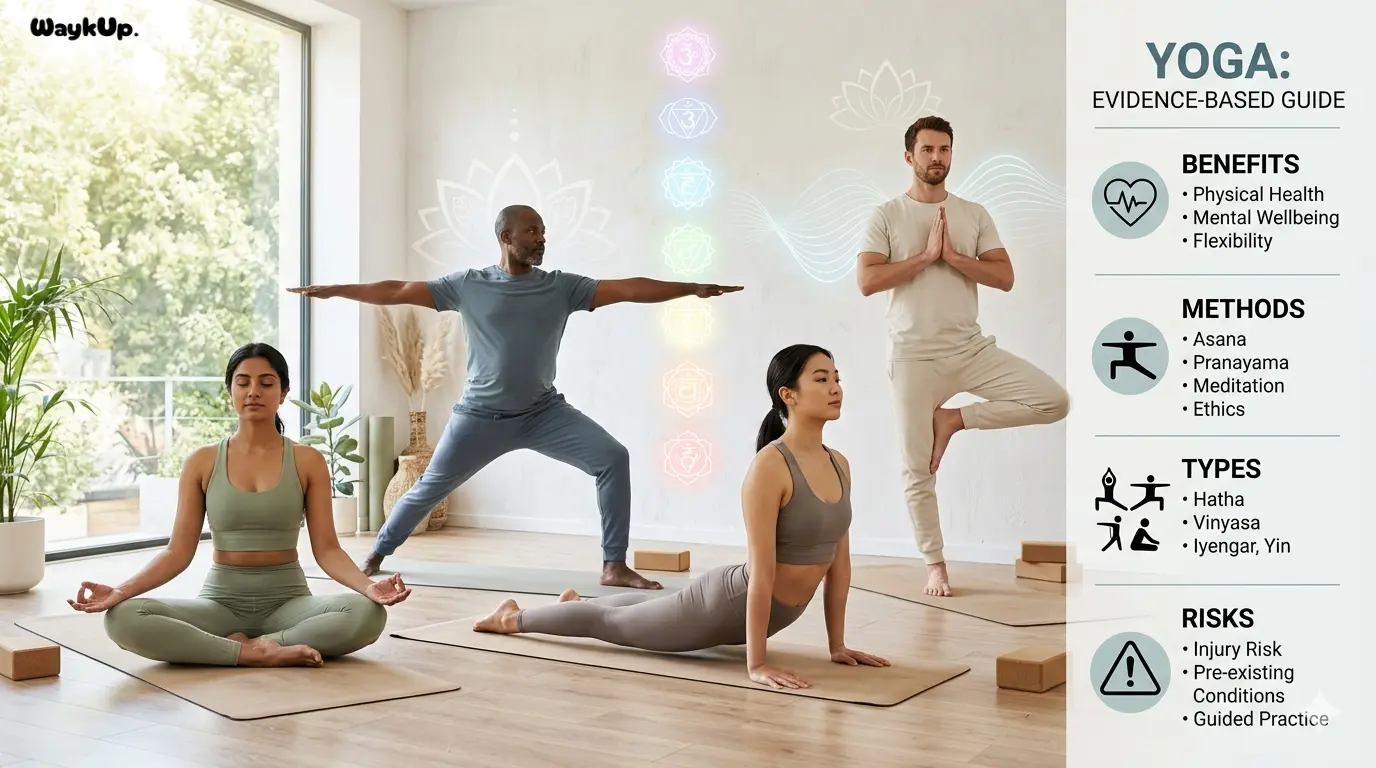
Quick Answer: Yoga is an ancient mind-body practice combining physical postures (asanas), controlled breathing (pranayama), and meditation (dhyana). Rooted in 5,000-year-old Indian philosophy, it offers scientifically proven benefits for flexibility, stress reduction, cardiovascular health, and mental well-being, with approximately 300 million practitioners worldwide today.
What Is Yoga? A Complete Definition
Yoga is a holistic mind-body discipline that unites three foundational pillars: physical postures (asanas), breathwork (pranayama), and meditation (dhyana). The word “yoga” derives from the Sanskrit root yuj, meaning “to yoke” or “to unite” reflecting its core purpose of connecting the individual self with universal consciousness.
While many in the West associate yoga primarily with fitness and flexibility, its original intent was far deeper: to achieve spiritual liberation (moksha) and mental discipline. Today, yoga functions simultaneously as a physical workout, a stress-management system, a therapeutic tool, and a spiritual path making it one of the most versatile wellness practices in human history.
There are an estimated 300 million yoga practitioners worldwide, spanning diverse religions and cultural backgrounds, with the highest concentration in India, followed by Europe and North America.
The History and Origin of Yoga
Yoga’s documented history spans 2,500 to 5,000 years, with the earliest known mention appearing in the Rigveda, one of the four sacred Hindu texts (Vedas) and among the oldest written collections in the world. These texts provided foundational guidelines for living a moral, disciplined, and harmonious life.
Key Historical Milestones
Pre-Classical Yoga (5,000–2,500 BCE): The initial seeds of yoga philosophy are found in the Vedic tradition. Yoga at this stage was primarily ritualistic and focused on expansion of consciousness through chanting, sacrifice, and ascetic practices.
Classical Yoga (~200 CE): The sage Patanjali systematized yoga philosophy in the Yoga Sutras, a collection of 196 aphorisms that remain the definitive text of classical yoga. Patanjali introduced the Eight-Limbed Path (Ashtanga) as a structured road to liberation.
Post-Classical Yoga (500–1500 CE): Yoga masters moved away from focusing solely on the mind and began exploring the body as a vehicle for enlightenment. Tantra yoga and Hatha yoga emerged during this period, emphasizing physical purification as a path to spiritual awakening.
Modern Yoga (Late 19th Century–Present): As Europeans colonized India, yoga began attracting global attention. Figures like Swami Vivekananda introduced yoga to the Western world in the late 1800s. In the 20th century, teachers like B.K.S. Iyengar, T.K.V. Desikachar, and Sri K. Pattabhi Jois codified the physical systems most popular today.
Core Philosophy: The 8 Limbs of Yoga
Patanjali’s Ashtanga (“eight-limbed”) framework remains the philosophical backbone of classical yoga. These eight limbs are not sequential steps but interconnected practices to be cultivated simultaneously.
|
Limb |
Sanskrit |
Meaning |
|
1 |
Yama |
Ethical restraints (non-violence, truthfulness, non-stealing) |
|
2 |
Niyama |
Personal observances (cleanliness, contentment, self-discipline) |
|
3 |
Asana |
Physical postures |
|
4 |
Pranayama |
Breath regulation |
|
5 |
Pratyahara |
Withdrawal of senses |
|
6 |
Dharana |
Concentrated focus |
|
7 |
Dhyana |
Meditative absorption |
|
8 |
Samadhi |
Enlightened union / liberation |
Most Western yoga practice focuses heavily on Asana (posture), but authentic yoga philosophy insists that without the Yamas and Niyamas, the ethical and personal conduct guidelines, physical practice alone is incomplete.
The 6 Major Branches of Yoga
Beyond Patanjali’s framework, yoga manifests in six primary philosophical branches:
- Hatha Yoga – The physical branch; foundation for most modern styles
- Raja Yoga – The royal path of meditation and mental mastery
- Karma Yoga – The path of selfless action and service
- Bhakti Yoga – The devotional path of love and worship
- Jnana Yoga – The intellectual path of wisdom and self-inquiry
- Tantra Yoga – The path of ritual and energy transformation
The 7 Chakras Explained
Integral to yogic philosophy is the concept of chakras, seven energy centers aligned along the spine that regulate physical, emotional, and spiritual well-being. Yoga practice, particularly pranayama and specific asanas, is believed to activate and balance these centers.
- Muladhara (Root Chakra) – Base of spine; governs survival and grounding
- Svadhisthana (Sacral Chakra) – Lower abdomen; governs creativity and pleasure
- Manipura (Solar Plexus Chakra) – Navel area; governs personal power and confidence
- Anahata (Heart Chakra) – Center of chest; governs love and compassion
- Vishuddha (Throat Chakra) – Throat; governs communication and truth
- Ajna (Third Eye Chakra) – Between eyebrows; governs intuition and insight
- Sahasrara (Crown Chakra) – Top of head; governs spiritual connection
Types of Yoga: A Definitive Breakdown
Understanding the different styles of yoga helps practitioners choose the most suitable approach for their goals, fitness level, and temperament.
Hatha Yoga
The broadest category of physical yoga. “Hatha” encompasses all yoga that involves physical postures. Most beginner-friendly and widely practiced. Suitable for all fitness levels; focuses on correct alignment and foundational poses held for several breaths.
Vinyasa Yoga
A dynamic, flow-based style where postures are sequenced continuously in synchrony with the breath. Each inhale and exhale triggers a movement. Excellent for building cardiovascular fitness, strength, and flexibility simultaneously.
Ashtanga Yoga
A rigorous, highly structured system developed by Pattabhi Jois. Consists of six sequential series of postures practiced in a fixed order. Physically demanding; best suited for intermediate to advanced practitioners seeking a disciplined, athletic practice.
Iyengar Yoga
Developed by B.K.S. Iyengar, this precision-focused style uses props (blocks, straps, bolsters) to achieve correct alignment. Particularly beneficial for injury rehabilitation, beginners, and older adults. One of the most therapeutically validated forms of yoga.
Kundalini Yoga
A spiritually oriented practice aimed at awakening dormant energy (kundalini) at the base of the spine. Combines dynamic postures, breathing techniques, chanting (mantra), and meditation. Focuses more on energetic and psychological transformation than physical fitness.
Yin Yoga
A slow, meditative style where postures are held passively for 3–5 minutes, targeting the body’s deep connective tissues (fascia, ligaments, joints). Deeply restorative; complements more active exercise styles.
Restorative Yoga
Extremely gentle and passive, postures are held using extensive prop support, allowing the body to completely relax. Activates the parasympathetic nervous system (rest-and-digest response). Ideal for stress recovery, illness, and mental burnout.
Bikram / Hot Yoga
A fixed sequence of 26 postures practiced in a room heated to approximately 40°C (104°F) with 40% humidity. Aims to detoxify through sweat, improve flexibility, and challenge cardiovascular endurance. Requires proper hydration and medical clearance for heart conditions.
Power Yoga
A Western adaptation of Ashtanga, athletically intense, gym-style yoga emphasizing strength and endurance. Less spiritually oriented; popular in fitness centers.
Prenatal Yoga
Specifically designed for pregnant women across all trimesters, focusing on hip opening, pelvic floor strength, breathwork for labor, and mental relaxation. Always recommended under certified instruction.
Science-Backed Health Benefits of Yoga
Yoga’s health benefits are no longer based solely on tradition, decades of peer-reviewed research from institutions including Harvard Medical School, the National Institutes of Health (NIH), and major clinical journals now confirm multiple therapeutic effects.
Physical Health Benefits
Improved Flexibility and Strength Regular yoga practice progressively stretches and strengthens muscles, tendons, and fascia. Studies show measurable improvements in hamstring flexibility, spinal mobility, and shoulder range of motion within 8–12 weeks of consistent practice.
Cardiovascular Health Research published in peer-reviewed journals shows yoga reduces resting heart rate, lowers blood pressure, and improves lipid profiles (reducing LDL “bad” cholesterol). A regular yoga practice is associated with reduced risk of heart disease, particularly valuable for those with prehypertension.
Back Pain Relief Among yoga’s most clinically supported benefits is relief from chronic lower back pain. Several systematic reviews confirm yoga is as effective as, and sometimes superior to, standard physiotherapy for non-specific chronic lower back pain.
Weight Management While yoga burns fewer calories than high-intensity exercise, its effect on cortisol reduction, improved insulin sensitivity, and mindful eating behaviors contributes to sustainable weight management. Restorative yoga in particular has been associated with abdominal fat reduction.
Improved Sleep Quality Multiple studies demonstrate that yoga, especially gentle and restorative styles, significantly improves sleep quality, reduces the time needed to fall asleep, and decreases nighttime waking. This effect is mediated through nervous system regulation and cortisol reduction.
Mental Health Benefits
Stress and Anxiety Reduction Yoga’s most documented psychological benefit is stress reduction. By activating the parasympathetic nervous system through controlled breathing and mindful movement, yoga measurably reduces cortisol levels, the body’s primary stress hormone. Studies indicate consistent yoga practice produces anxiety reduction comparable to cognitive behavioral therapy in some populations.
Depression Management Several randomized controlled trials demonstrate yoga reduces symptoms of major depressive disorder, with benefits partly attributed to increased GABA (gamma-aminobutyric acid) levels, a neurotransmitter that regulates mood and is often deficient in depression.
Enhanced Focus and Cognitive Function Yoga’s meditative components improve attention, executive function, and working memory. Research involving both youth and older adults shows measurable cognitive improvements, with particular promise for age-related cognitive decline.
Reduced PTSD Symptoms Trauma-sensitive yoga has emerged as a clinically validated complementary therapy for post-traumatic stress disorder (PTSD), helping survivors reconnect with body sensation in a safe, controlled way.
Therapeutic Applications
|
Condition |
Evidence Level |
Recommended Style |
|
Chronic Lower Back Pain |
Strong |
Iyengar, Hatha |
|
Anxiety Disorders |
Strong |
Restorative, Kundalini |
|
Hypertension |
Moderate–Strong |
Hatha, Restorative |
|
Type 2 Diabetes |
Moderate |
Hatha, Vinyasa |
|
Arthritis |
Moderate |
Iyengar, Chair Yoga |
|
Depression |
Moderate |
Vinyasa, Kundalini |
|
Insomnia |
Moderate |
Yin, Restorative, Nidra |
|
PTSD |
Emerging |
Trauma-Sensitive Yoga |
Yoga Risks, Side Effects, and Safety Guidelines
Yoga is widely considered safe for most healthy adults, but like any physical practice, it carries risks, particularly when practiced incorrectly, too intensely, or without appropriate medical guidance.
Common Injuries
The most frequently reported yoga-related injuries involve:
- Lower back – often from forward folds and twists performed with poor alignment or overstretching
- Shoulders and neck – particularly in inversions like headstands and shoulder stands
- Hamstrings – from aggressive forward bends without adequate warmup
- Knees – especially in lotus (padmasana) or pigeon pose when forced beyond range
Studies indicate that most yoga injuries result from practicing beyond one’s current capacity, receiving inadequate instruction, or ignoring pain signals.
High-Risk Poses to Approach with Caution
- Headstand (Sirsasana) – Risk of cervical spine injury if weight is not properly distributed through arms
- Shoulder Stand (Sarvangasana) – Pressure on neck vertebrae; contraindicated for neck injuries
- Full Lotus (Padmasana) – Extreme knee rotation; requires genuine hip mobility first
- Extreme Backbends (Wheel/Upward Bow) – Lumbar compression risk if thoracic spine is inflexible
Medical Contraindications
Yoga may be inadvisable or require modification for individuals with:
- Uncontrolled hypertension – Inversions can spike blood pressure dangerously
- Glaucoma – Increased intraocular pressure from inversions
- Severe osteoporosis – Spinal flexion poses increase fracture risk
- Recent surgeries – Joint replacements, abdominal surgery
- Late pregnancy – Deep twists and inversions should be avoided
- Active disc herniation – Forward bends can worsen nerve compression
Safety Best Practices
- Always inform your instructor of injuries, medical conditions, or surgeries before class
- Start with beginner or gentle classes – progressing to advanced styles over months, not days
- Respect the “edge” – the point of sensation, not pain; pain is a signal to stop
- Prioritize alignment over depth – going deeper is never the goal at the expense of form
- Hydrate appropriately, especially in hot yoga
- Get medical clearance before beginning yoga if you have cardiovascular disease, osteoporosis, or neurological conditions
Yoga Trends Dominating 2026
The global yoga market is experiencing remarkable growth and innovation in 2026. Here are the most significant trends reshaping the practice:
1. Walking Yoga: The Fastest-Growing Fitness Trend
The most dramatic trend of 2026 is walking yoga. Searches for “walking yoga” have surged 2,414% since 2024, making it the fastest-growing fitness trend of the year. This hybrid practice integrates mindful breathwork, body awareness, and meditative attention into walking – requiring no gym membership, specialized equipment, or prior flexibility.
2. The $119 Billion Yoga Market
The global yoga market, valued at approximately $63.82 billion in 2025, is projected to grow to $119.69 billion by 2034 at a CAGR of 7.29%. This explosive growth is driven by increasing mental health awareness, digital delivery platforms, and post-pandemic wellness consciousness.
3. Yoga and Pilates Popularity Surge
Survey data from CivicScience (January 2026) shows yoga/Pilates has seen the largest participation increase among fitness disciplines, rising four percentage points from 13% to 17% of regular exercisers, outpacing cross-training and competitive sports in growth rate.
4. Recovery-First Yoga Philosophy
Following years of high-intensity fitness culture, 2026 sees a significant pivot toward recovery-oriented yoga. Yin yoga, restorative yoga, yoga nidra, and sound healing classes are experiencing surging enrollment. Mental health is now the primary motivator for movement among a significant share of practitioners.
5. Adaptive and Inclusive Yoga
The 2026 market strongly emphasizes inclusivity: adaptive yoga for seniors and people with disabilities, “Broga” (yoga for men focused on functional mobility), prenatal yoga, and trauma-sensitive yoga are all growing rapidly. Yoga is no longer perceived as a niche practice for young, flexible women.
6. Digital and Hybrid Yoga Platforms
AI-powered personalization, virtual yoga studios, and hybrid class formats (in-person + live-streamed simultaneously) are among the fastest-growing segments of the yoga industry. Apps offering adaptive programs based on user feedback and biometric data are transforming home practice.
7. Corporate Wellness Yoga
Companies are increasingly integrating yoga into employee wellness programs, recognizing its evidence-based benefits for stress reduction, focus, and burnout prevention. Corporate yoga is one of the fastest-growing B2B wellness verticals in 2026.
How to Start Yoga as a Beginner
Starting yoga doesn’t require flexibility, special equipment, or prior experience. Here’s a practical, evidence-based framework:
Step 1: Choose the Right Style Beginners benefit most from Hatha yoga, Iyengar yoga, or gentle/restorative classes. Avoid Power Yoga, Ashtanga (led), or Bikram Hot Yoga until you have at least 6 months of foundational practice.
Step 2: Essential Equipment You need only a yoga mat. Optional additions include two yoga blocks, a strap, and a bolster. Wear comfortable, non-restrictive clothing.
Step 3: Start with 2–3 Sessions per Week Research indicates that 2–3 sessions per week for 8–12 weeks produces measurable physical and psychological benefits. Consistency matters more than duration, even 20-minute sessions yield results.
Step 4: Learn Key Foundational Poses Begin with: Mountain Pose (Tadasana), Child’s Pose (Balasana), Downward-Facing Dog (Adho Mukha Svanasana), Warrior I & II, Seated Forward Fold, Bridge Pose, Corpse Pose (Savasana).
Step 5: Find a Qualified Instructor For in-person classes, look for instructors certified through Yoga Alliance (RYT-200 or RYT-500). In regions like India, certifications aligned with the Yoga Certification Board (YCB) are becoming the professional gold standard for safety and authenticity.
Step 6: Integrate Breathwork Even basic awareness of inhaling during expansion and exhaling during contraction significantly deepens the practice from the very first session.
Curious about reducing belly fat ? check out recent blog – How to Reduce Belly Fat in 7 Days
Frequently Asked Questions (FAQs)
What is yoga in simple terms?
Yoga is an ancient Indian practice combining physical postures, controlled breathing, and meditation to improve physical health, mental well-being, and (in traditional contexts) spiritual development. Today it is practiced globally as both a fitness discipline and a holistic wellness system.
How many types of yoga are there?
There are six major philosophical branches (Hatha, Raja, Karma, Bhakti, Jnana, Tantra) and dozens of modern physical styles. The most common physical styles practiced globally include Hatha, Vinyasa, Ashtanga, Iyengar, Kundalini, Yin, Restorative, Bikram/Hot, and Power Yoga.
Is yoga a religion?
Yoga originated within Hinduism and shares philosophical elements with Buddhism and Jainism. However, modern yoga as a physical and wellness practice is non-religious and is practiced by people of all faiths and none. Practitioners can engage with yoga at any level of spiritual depth they choose.
How long does it take to see results from yoga?
Most practitioners report noticeable improvements in flexibility, stress levels, and sleep quality within 4–8 weeks of regular practice (2–3 sessions per week). Significant strength gains and postural improvements typically emerge within 3–6 months.
Can yoga help with weight loss?
Yoga contributes to weight management through multiple mechanisms: reducing stress hormones (cortisol) that promote fat storage, building lean muscle mass, improving insulin sensitivity, and cultivating mindful eating behaviors. While yoga alone burns fewer calories than aerobic exercise, its hormonal and behavioral effects make it highly complementary to a weight management plan.
Is yoga safe during pregnancy?
Prenatal yoga, taught by a certified instructor, is generally safe and beneficial throughout all trimesters. It supports pelvic floor strength, reduces lower back pain, manages stress, and prepares the body for labor. Deep twists, inversions, and lying on the back (after the first trimester) should be avoided. Always consult your obstetrician before starting.
Can yoga replace going to the gym?
Yoga can replace some gym functions, particularly flexibility training, bodyweight strength, and stress management, but does not fully replicate the benefits of progressive resistance training or high-intensity cardiovascular exercise for muscle hypertrophy, bone density, and VO2 max. An integrated approach combining yoga with strength and cardio training is optimal for comprehensive fitness.
What is the best time of day to practice yoga?
Morning yoga (Brahma muhurta, approximately 6 AM) is traditionally recommended and may improve alertness and set a mindful tone for the day. Evening yoga, particularly restorative or yin styles, supports stress release and sleep quality. The best time is ultimately whichever time you can practice most consistently.
What are the risks of yoga?
The most common yoga-related injuries involve the lower back, shoulders, neck, hamstrings, and knees, most commonly resulting from practicing beyond one’s current ability, poor alignment, or inadequate instruction. Yoga is contraindicated or requires modification for certain conditions including uncontrolled hypertension, glaucoma, severe osteoporosis, and recent surgery. Always consult a qualified instructor and physician when in doubt.
What is the difference between yoga and meditation?
Yoga is a comprehensive system that includes physical postures, breathwork, and meditation. Meditation (dhyana) is specifically the seventh limb of Patanjali’s Eight-Limbed Path and refers to the state of sustained, non-judgmental focus, a component within yoga, not separate from it. All meditation can be considered part of yoga, but not all yoga involves formal seated meditation.
Conclusion
Yoga is one of humanity’s most enduring, scientifically validated, and universally accessible wellness systems. From its ancient roots in Vedic philosophy to its 2026 incarnation as a $63 billion global industry, yoga continues to evolve, while its foundational purpose remains unchanged: to unite body, mind, and spirit in a state of balanced, conscious awareness.
Whether you approach yoga as a physical discipline, a mental health tool, a spiritual practice, or all three, the evidence is clear: consistent, mindful practice delivers measurable, meaningful benefits across virtually every dimension of human health.