

















 Follow Us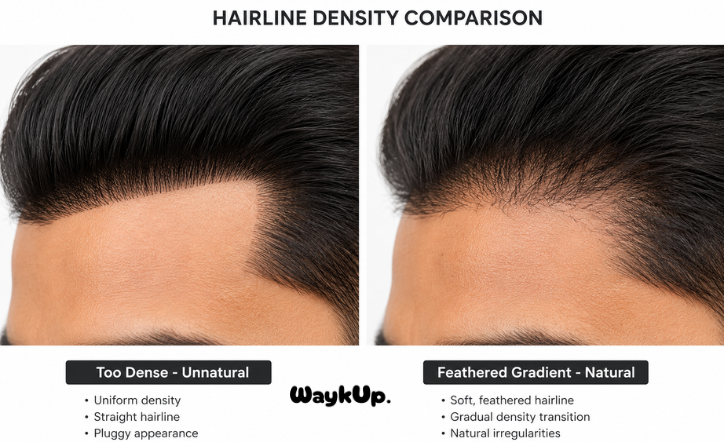
If you have ever looked at someone and immediately thought their hair transplant looks fake, the hairline density was almost certainly the reason. Most people assume that more hair at the front equals a more natural result. In reality, the opposite is true. A properly designed hairline actually starts sparse and builds gradually, and that deliberate reduction in front density is what makes it believable. Here is the science behind why.
For more on hair health, grooming, and scalp care, visit the Grooming section on WaykUp.
The Core Idea: Your Eye Reads Softness, Not Bulk
Look at any natural hairline, whether on a young person who has never lost hair or an older person with a mature hairline, and you will notice something consistent. The very front edge is never dense. It is soft, slightly translucent, irregular, and gradual. Density only builds as you move further back onto the scalp.
This is not a cosmetic choice. It is how every human hairline naturally grows. Fine, individual hairs form a soft frame at the outermost edge. Thicker, multi-strand growth sits further back. The brain processes this gradual fade as natural skin, not as hair loss, because it matches everything we have ever seen on real heads.
When a hairline violates this principle, whether through a transplant with multi-hair grafts placed at the very front, or simply hair that grows too densely right at the edge, the brain flags it immediately as unusual. That is what creates the pluggy, painted-on look that defines bad hair transplant results.
The Three-Zone Density Model
Modern hair transplant surgeons and hairline design experts use a three-zone model to plan a natural result:
Zone 1: The Transition Edge
Exclusively single-hair follicular units placed at a shallow angle of 10 to 15 degrees. This feathered edge is soft, slightly irregular, and semi-transparent when light hits it from the side. Think of it like pencil shading that starts very light. The density here targets around 15 to 20 grafts per square centimetre, deliberately lower than anywhere else.
Zone 2: The Defined Front
Two-hair grafts placed slightly further back add definition behind the soft edge. Density increases to around 30 to 40 grafts per square centimetre in this zone. This is the area that creates the visible impression of a hairline when looking at someone head-on from a normal conversational distance.
Zone 3: The Mid-Scalp Build
Three-hair and multi-hair grafts placed in the mid-scalp and crown provide real density and coverage. This is where the visual weight of the hair lives. Because Zone 1 and Zone 2 create a soft, believable foreground, the eye accepts the transition and reads the overall result as full and natural.
The key insight is that the front zone is doing something specific: it creates the frame. The real density sits behind it. When the front is overloaded with grafts, it eliminates the gradient entirely, and the result looks like hair was stamped onto the scalp in a straight line.
Why This Matters Specifically for Indian Men
Most Indian men have dark, straight, fine-to-medium hair against medium-to-dark skin tones. This specific combination is one of the less forgiving for hairline errors, because the contrast between dark hair and the scalp is high, making density irregularities very visible in daylight and under phone cameras.
A common mistake in lower-quality hair transplant clinics across India is packing too many grafts into the hairline to create an impressive before-and-after photo. The result looks impressive in clinic lighting but becomes obvious outdoors within months as the hair grows in at incorrect angles or with unnatural density at the very front.
- Signs of a poorly designed hairline: Too straight, too low, too dense at the front, or designed without considering the likely progression of future hair loss
- Signs of a well-designed hairline: Soft, slightly irregular front edge, density that builds gradually as you move back, age-appropriate placement, no visible graft clusters at close inspection
- The angle matters: Grafts placed at the front must exit the scalp at 10 to 15 degrees to lie flat. Vertical placement is one of the most common causes of unnatural growth direction
For a deeper look at hair loss solutions and medical treatments available in India, explore the Health and Fitness section on WaykUp.
What to Ask Before Any Hairline Procedure
- Ask your surgeon to explain their hairline density design before any procedure begins. A confident, experienced surgeon will walk you through the three-zone approach and explain why the front will be softer than the middle
- Ask to see examples of their work at six months and one year, not just immediately after surgery. Unnatural density and angle errors only become fully visible as hair grows
- Be cautious of clinics that promise the densest possible front hairline. More grafts at the front is not a sign of quality. It is often a sign that artistic judgment is missing from the process
- Consider your age and future hair loss pattern. A hairline designed for a 25-year-old face may look odd on a 45-year-old face if surrounding hair continues to thin. Good surgeons plan for this.
Final Thoughts
Hairline density is an optical illusion, and it works best when the density is deliberately reduced at the front. Nature designed it this way. The most skilled surgeons in the world replicate it the same way. Before any hairline procedure, understanding this principle is the single most important thing you can do to protect your result. Less at the front is not a compromise. It is the correct design.
Frequently Asked Questions (FAQ)
Q1. Why does a lower density hairline look more natural?
Because natural hairlines always start sparse at the front edge and build density further back. A dense front immediately looks artificial to the human eye because it does not match what we recognise as natural.
Q2. What are single-hair grafts and why are they used at the hairline?
Single-hair follicular units are grafts containing just one hair strand. They are placed at the front edge of the hairline to create a soft, feathered, natural-looking transition rather than a harsh, dense border.
Q3. What angle should hairline grafts be placed at?
The front edge grafts should be placed at a shallow angle of 10 to 15 degrees so the hair lies flat against the scalp. Vertical placement is one of the most common causes of unnatural growth direction.
Q4. What is the ideal graft density for a natural hairline?
The very front transition zone typically targets around 15 to 20 grafts per square centimetre with single-hair units. The defined front zone builds to 30 to 40 grafts per cm2. The mid-scalp uses multi-hair grafts at higher density to create real coverage.
Q5. What makes a hair transplant look pluggy or fake?
Multi-hair grafts placed at the very front edge, a straight or overly low hairline, incorrect graft angle, or excessive uniform density at the front are all common causes of an unnatural, pluggy appearance.
Q6. Should Indian men be concerned about hairline design?
Yes. Dark hair against medium-to-dark skin has high contrast, which makes density irregularities and angle errors more visible. Careful hairline design and surgeon selection is especially important for Indian patients.