
















 Follow Us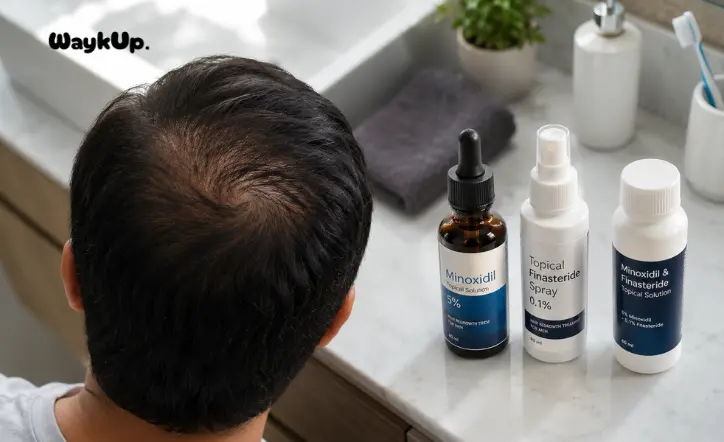
Hair loss is one of the most common concerns among Indian men and women today. Whether it starts with a receding hairline, a thinning crown, or wider parting, the emotional impact of losing hair is real. And while the market is flooded with oils, serums, and home remedies that promise miraculous results, the treatments that are actually backed by clinical evidence are much fewer.
The good news is that science has made significant progress in the last decade. Three topical treatments in particular have consistently demonstrated real results for androgenetic alopecia, the most common form of hair loss: Minoxidil, topical Finasteride, and the combination of both. This guide explains how each one works, what the evidence says, and who they are best suited for.
For more on grooming and personal care routines, visit the Grooming section on WaykUp.
Understanding Advanced Hair Loss First
Most hair loss in men, and a significant proportion in women, is androgenetic alopecia, also called pattern baldness. It is driven by a combination of genetics and the hormone dihydrotestosterone (DHT). DHT causes hair follicles to shrink over time, producing progressively thinner and shorter strands, until the follicle eventually stops producing hair altogether.
Advanced hair loss means the process has progressed significantly, with visible thinning or balding across the temples, crown, or both. At this stage, the focus shifts from prevention to slowing further loss and, where possible, stimulating regrowth in follicles that are still viable.
Topical treatments work because they are applied directly to the scalp, allowing active ingredients to reach follicles locally. This also means they tend to cause fewer systemic side effects compared to oral medications.
Quick Comparison: The Three Main Topical Treatments
|
Treatment |
How It Works |
Best For |
Key Concern |
|
Minoxidil 5% (Topical) |
Boosts scalp blood flow, prolongs growth phase |
All stages of hair loss, men and women |
Must be used continuously |
|
Topical Finasteride 0.1% |
Reduces DHT at scalp level locally |
Men with androgenetic alopecia |
Not for women of childbearing age |
|
Minoxidil + Finasteride (Combo) |
Dual action: blood flow + DHT blocking |
Moderate to advanced male pattern baldness |
Doctor consultation required |
Treatment 1: Minoxidil (Topical)
Minoxidil is the most widely used and best-studied topical hair loss treatment in the world. It is available without prescription in India and is sold under brand names like Tugain, Mintop, and Rogaine in concentrations of 2% (commonly used for women) and 5% (more commonly recommended for men).
How It Works
Minoxidil is a potassium channel opener that works by widening blood vessels in the scalp, improving blood flow and oxygen delivery to hair follicles. This extended blood supply helps follicles move from the resting phase (telogen) into the active growth phase (anagen) and stay there for longer. The result, over months of consistent use, is a slowing of hair loss and, in many cases, visible regrowth of finer hair strands.
Importantly, minoxidil does not address the root hormonal cause of androgenetic alopecia. It works on the blood supply side of the equation, not the DHT side.
What the Evidence Says
Multiple clinical studies and a comprehensive Indian review published in the IP Indian Journal of Clinical and Experimental Dermatology (2025) confirmed that topical minoxidil is effective for both male and female patterned hair loss across five different measurement parameters. Results are typically seen between 3 and 6 months of consistent use.
- Clinically proven to slow hair loss and stimulate regrowth in most users
- Available over the counter in India at highly accessible price points
- Results require continuous use, stopping treatment leads to reversal of gains within months
- Most common side effects include scalp irritation, dryness, and initial shedding in the first few weeks
Who Should Use It
Minoxidil is suitable for both men and women experiencing pattern hair loss at any stage. The 5% formulation is generally more effective for men. Women are typically advised to use the 2% formulation or the specific 5% foam version, which has lower risk of systemic absorption. Always begin with a dermatologist’s guidance on concentration and frequency.
Treatment 2: Topical Finasteride
Oral finasteride has been a standard treatment for male pattern baldness for decades, but concerns about systemic side effects led researchers to develop a topical version. Topical finasteride delivers the active ingredient directly to the scalp while significantly reducing the amount that enters the bloodstream, making it an important development for men who want the benefits of finasteride with a better safety profile.
How It Works
Finasteride is a 5-alpha reductase inhibitor. It blocks the enzyme responsible for converting testosterone into DHT. By reducing DHT levels at the scalp, topical finasteride directly addresses the hormonal driver of androgenetic alopecia. This makes it mechanistically different from minoxidil, which does not affect DHT at all.
The topical formulation is available in concentrations of 0.1% to 0.25% and is applied directly to the affected scalp areas. A clinical trial published in the Journal of Drugs in Dermatology (2024) found the combination of topical finasteride 0.25% with minoxidil 5% to be significantly more effective than minoxidil alone.
What the Evidence Says
- Reduces scalp DHT levels effectively while minimising systemic absorption compared to oral finasteride
- Clinical studies confirm it maintains and improves hair density over time, particularly when combined with minoxidil
- Effective specifically for androgenetic alopecia in men
- Not recommended for women of childbearing potential due to risks related to DHT inhibition
- Available in India by prescription only, sold under formulations such as Morr F
Who Should Use It
Topical finasteride is recommended for men with mild to advanced androgenetic alopecia who want to address the hormonal cause of their hair loss without the systemic exposure of oral finasteride. It requires a dermatologist’s prescription in India and is not suitable for women who are pregnant or planning pregnancy.
Treatment 3: Combination Therapy (Minoxidil + Topical Finasteride)
This is where the most exciting and promising recent evidence sits. Combining minoxidil with topical finasteride addresses hair loss through two completely different mechanisms simultaneously, making it more effective than either treatment used alone for many patients with moderate to advanced hair loss.
Why the Combination Works
The logic is straightforward. Minoxidil improves blood flow and extends the growth phase of follicles. Topical finasteride reduces DHT and removes the hormonal trigger causing follicle miniaturisation. Together, they address both the cause and the consequence of androgenetic alopecia, a dual mechanism that neither treatment can achieve on its own.
A 2024 study from the Journal of Drugs in Dermatology and a 2025 systematic review and meta-analysis following PRISMA guidelines (reviewed in Frontiers in Pharmacology) both confirmed that combining minoxidil with finasteride consistently delivers superior outcomes over monotherapy for male pattern baldness.
What the Evidence Says
- Combination therapy outperforms either treatment used alone for androgenetic alopecia in men
- Particularly effective for patients who have not responded adequately to monotherapy alone
- Sold in India as a single combined topical solution under brand names including Morr F, approved specifically for alopecia treatment
- Side effects are generally mild and localised when used topically, including scalp irritation and initial shedding
- Requires medical supervision from a dermatologist before starting
How to Use Combination Therapy
The combined solution is typically applied once or twice daily to a clean, dry scalp. The treated area should not be washed for several hours after application. Consistent daily use over a minimum of 4 to 6 months is necessary before evaluating results.
Practical Guidance: What Indian Men and Women Should Know
- Consult a dermatologist first: Hair loss has multiple causes. Confirm with a qualified dermatologist that your hair loss is androgenetic alopecia and not caused by nutritional deficiency, thyroid issues, or another condition.
- Results take time: Visible improvement with any topical treatment typically takes 4 to 6 months. Stopping early is the most common mistake.
- Initial shedding is normal: Many people experience increased shedding in the first 2 to 4 weeks of starting minoxidil. This is temporary and indicates the treatment is working.
- Continuous use is mandatory: Stopping treatment reverses most gains. Plan for long-term consistent use before starting.
- Availability in India: Minoxidil is available over the counter. Topical finasteride and combination formulations like Morr F are prescription-only through a dermatologist.
For more on hair care and building a personal care routine, explore the Health and Fitness section on WaykUp.
Final Thoughts: Choose the Right Treatment for Your Stage
When it comes to advanced hair loss, topical treatments offer genuine, evidence-backed options. Minoxidil is the safest entry point and works well for most people. Topical finasteride adds a critical hormonal mechanism that minoxidil cannot provide. And combination therapy offers the most comprehensive approach currently available in topical form.
The most important step is getting a proper diagnosis from a dermatologist. With the right guidance, realistic expectations, and consistent use, topical treatments can make a meaningful difference to the health and density of your hair.
Frequently Asked Questions (FAQ)
Q1. What is the best topical treatment for advanced hair loss?
For men with moderate to advanced androgenetic alopecia, the combination of topical minoxidil 5% and topical finasteride 0.1% to 0.25% is currently considered the most effective topical approach based on clinical evidence. For women, topical minoxidil (2% or 5% foam) is the primary recommended option. Always consult a dermatologist first.
Q2. How long does topical minoxidil take to show results?
Most users see measurable improvements in hair density after 4 to 6 months of consistent daily use. Initial shedding in the first 2 to 4 weeks is normal. Full assessment of results is typically done at the 6-month mark, with some users continuing to improve up to 12 months of use.
Q3. Is topical finasteride safer than oral finasteride?
Yes, topical finasteride is associated with significantly lower systemic absorption than the oral form, which means reduced risk of systemic side effects. However, it still requires a doctor’s prescription in India and should not be used by women who are pregnant or planning to become pregnant.
Q4. Can I use minoxidil and topical finasteride together?
Yes, and clinical evidence supports this combination as more effective than either treatment alone for male androgenetic alopecia. Combined formulations are available in India by prescription under brand names including Morr F. Always start combination therapy under dermatologist supervision.
Q5. What happens if I stop using minoxidil?
Stopping minoxidil typically leads to a reversal of gains within 3 to 6 months, as the treatment does not address the underlying hormonal cause of hair loss. For sustained results, minoxidil needs to be used continuously. This is an important consideration before starting treatment.
Q6. Are topical hair loss treatments available in India?
Yes. Minoxidil is widely available over the counter in India in 2% and 5% concentrations under brands like Tugain and Mintop. Topical finasteride and combination formulations are available by prescription through dermatologists and pharmacies with a valid prescription.
Q7. Are these treatments suitable for women?
Topical minoxidil is clinically proven and widely used for female pattern hair loss. Topical finasteride is generally not recommended for women of childbearing potential. Women should always consult a dermatologist before starting any hair loss treatment.
Q8. Do topical treatments work for complete baldness?
Topical treatments work best when there are still viable hair follicles present. For areas of complete and long-standing baldness where follicles have been dormant for many years, topical treatments are unlikely to produce significant regrowth. A dermatologist can assess follicle viability and recommend the most suitable approach.