
















 Follow Us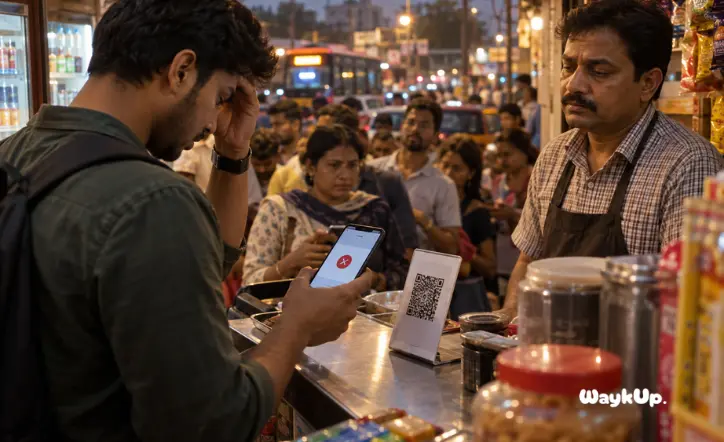
You are standing at a crowded chai stall in Delhi, scan the QR code, enter your UPI PIN, and the screen suddenly says “UPI payment failed.” Your bank account may still show a debit, while the shopkeeper says the money has not arrived.
This becomes more common when transaction traffic spikes, especially around lunch hours, evenings, salary dates, major online sales, festivals, or cricket match breaks. But the interesting part is that “UPI payment failed” does not always mean the same thing.
Why UPI Payments Fail More During Peak Hours
UPI is designed to operate 24×7, but the system still depends on several interconnected components.
A payment can involve your UPI app, your bank, the payer PSP, NPCI’s UPI infrastructure, the beneficiary bank or PSP, and the merchant’s payment setup.
If any part becomes slow or unavailable, the transaction can time out.
NPCI itself has previously highlighted the problem of banks taking downtime during peak hours. In a 2018 circular, NPCI specifically advised member banks to schedule maintenance between midnight and 5 AM because downtime during busy periods could cause a high number of declined transactions.
The scale of UPI today makes this even more relevant. NPCI’s statistics show that UPI processed 24.5 billion transactions in August 2026, worth roughly ₹29.82 lakh crore.
So when thousands or millions of users are trying to pay at roughly the same time, even a problem at one bank or service layer can become visible to customers.
When do peak-hour failures become noticeable?
Common situations include:
- Evening shopping hours
- Lunch and dinner rushes
- Salary and month-end periods
- Major e-commerce sales
- Festival shopping
- Cricket match breaks
- Ticket-booking windows
- Large online payment campaigns
The key point is that UPI itself does not necessarily have to be completely down.
Your bank’s UPI service may be experiencing an issue while another bank continues working normally.
What Actually Happens Behind a Failed UPI Payment
Consider a ₹500 payment at a restaurant.
You scan the restaurant’s QR code and approve the payment.
The request has to travel through multiple systems before the merchant receives confirmation.
A simplified flow looks like this:
Your phone → UPI app/PSP → Your bank → UPI infrastructure → Merchant’s bank/PSP → Merchant
Now imagine your bank accepts the request but becomes slow while responding.
Your UPI app may wait for a response. If that response does not arrive within the expected window, the transaction can eventually be treated as failed or timed out.
That is why you may see situations such as:
App: Payment failed
Bank: ₹500 debited
Merchant: Payment not received
This is not necessarily a case of money disappearing.
It can be a transaction-status or reconciliation issue.
NPCI distinguishes technical declines from business declines. Technical declines can happen because of system or network availability issues at the bank or NPCI side.
Technical Decline vs Business Decline
This distinction explains why two people standing next to each other can experience completely different UPI results.
Technical decline
A technical decline is connected to infrastructure or system problems.
Examples include:
- Bank system unavailability
- Network problems
- System timeouts
- Communication failures
- Problems at a payment-processing layer
NPCI describes technical decline as a transaction decline caused by technical reasons such as system unavailability or network issues on the bank or NPCI side.
This is the type of failure that can become more visible during a busy period.
Business decline
A business decline is different.
It can happen because of reasons such as:
- Incorrect UPI PIN
- Incorrect beneficiary information
- Transaction limit being exceeded
- Daily transaction count limits
- Other bank-defined business rules
NPCI specifically classifies these as business declines when the reason is not a technical problem with the bank or NPCI system.
So if your UPI payment fails at 2 PM and your friend successfully pays using another bank, that does not automatically prove that UPI is down.
The failure may be specific to your bank, PSP, account, or transaction.
Why Your Money Can Be Debited Even When Payment Fails
This is the part that causes the most panic.
You pay ₹2,000 for an online order.
The merchant page says the payment failed.
You check your banking app and see that ₹2,000 has been debited.
What happened?
The payment may have reached one stage successfully but failed to receive or communicate the final confirmation.
RBI’s failed-transaction framework specifically covers UPI cases where the customer’s account is debited but the beneficiary does not receive the money. For UPI fund transfers, the framework requires reversal if the beneficiary cannot be credited, generally by T+1 day. For merchant payments where the account is debited but confirmation is not received, the prescribed auto-reversal timeline is T+5 days.
This distinction matters.
A failed UPI payment is not always an immediate reversal.
The banking system may first need to reconcile what happened.
What should you do before paying again?
This is where people often create a second problem.
Suppose the first payment shows “failed”, but your bank has already debited ₹1,000.
You immediately try again.
The second transaction succeeds.
Now you have potentially paid ₹2,000 for a ₹1,000 purchase.
Instead, first check UPI transaction status in your UPI app or bank application.
Look for whether the transaction is:
- Failed
- Pending
- Successful
- Reversed
The exact wording varies between banks and apps.
What to Do When UPI Fails During a Rush
If you are at a crowded shop, metro-area restaurant, petrol pump or food counter, avoid repeatedly tapping “Pay”.
Use this sequence instead:
1. Check the transaction status
Open your UPI app or banking application and check the transaction history.
Do not rely only on the merchant’s screen.
2. Check your bank balance
If the amount was debited, note the exact amount and transaction reference.
3. Ask the merchant to check their side
The merchant may have a different status from what your app displays.
4. Wait before attempting the same payment again
If the first transaction is pending, repeating it immediately creates a duplicate-payment risk.
5. Use another payment method if the situation is urgent
For a small offline purchase, cash or a card can be useful as a backup.
This is particularly practical at crowded counters where you cannot afford to keep the queue waiting.
The Real-World Peak-Hour Problem Most Users Miss
Here is a very Indian example.
Imagine a busy food court in Noida at around 8:30 PM.
Twenty customers are ordering at different counters. Almost everyone is scanning QR codes. Several users are on the same mobile network, while the merchants may be using different banks and payment providers.
One customer’s PhonePe payment works instantly.
Another customer’s Google Pay transaction remains pending.
A third person’s bank account gets debited, but the restaurant’s merchant device does not receive confirmation.
People often describe this as “UPI is down.”
Technically, that conclusion can be wrong.
The failure could be isolated to one bank, one PSP, one merchant-acquiring route, a communication link, or a temporary timeout.
NPCI’s ecosystem data explicitly separates technical declines from business declines, which shows why looking at every failed transaction as the same problem gives an incomplete picture.
There is another useful clue: NPCI’s own historical guidance recognised that bank-side downtime during busy periods could create large numbers of declined transactions.
So the better question is not simply “Why is UPI down?”
It is:
“Which part of the UPI transaction failed, and did my bank actually debit the money?”
That one distinction can prevent duplicate payments.
What About Without Internet UPI Payment?
The phrase “without internet UPI payment” can be confusing because standard UPI transactions generally depend on connectivity between the relevant systems.
There are offline or low-connectivity payment options under India’s digital-payment ecosystem, but you should not assume that a normal QR-code UPI transaction will automatically complete when your mobile data disappears.
If your internet connection is unstable during a peak period, the app may also struggle to send the payment request or receive the final confirmation.
This means there can be two separate problems:
Your phone cannot communicate properly
or
the payment infrastructure cannot respond properly
They can look almost identical on your screen.
For more technology coverage, you can also explore WaykUp’s Gadgets & Technology section and related articles such as Best Smartphones Under ₹20,000 in India, Ulaa, India’s Swadeshi Browser, 10 Essential Gadgets for Gaming on the Go, and Vivo X500 Pro Max vs Vivo X500. WaykUp
People Also Ask
1. Why does UPI fail more during peak hours?
Peak-hour failures can occur when banks, PSPs or connected systems experience unusually high transaction loads, technical problems or scheduled downtime. NPCI has previously warned that bank downtime during busy periods can result in higher transaction declines.
2. What is a technical decline in UPI?
A technical decline occurs because of technical problems such as system unavailability or network issues involving the bank or NPCI side. It is different from a business decline caused by factors such as an incorrect PIN or transaction-limit rules.
3. What should I do if my UPI payment failed but money was debited?
First check the transaction status instead of immediately paying again. RBI’s framework provides timelines for auto-reversal when a UPI transaction is debited but the beneficiary or merchant does not receive the payment.
4. How can I check UPI transaction status after a failed payment?
Open the UPI app or banking app used for the payment and check the transaction history. Look for the current status and transaction reference before attempting another payment.
5. Can a wrong UPI transaction happen after a failed payment?
Yes, if you repeat a payment before confirming what happened to the first transaction, you can potentially make two successful payments. This is why checking the first transaction’s status is especially useful during peak-hour failures.
6. Does UPI work without internet?
A normal UPI transaction generally requires connectivity for the app and payment systems to communicate. Special offline or low-connectivity payment mechanisms exist, but you should not assume that an ordinary QR payment will complete without an internet connection.